Posts

Showing posts with the label aging ovens

Epcon Featured in Thermal Processing Magazine

Image
We’re excited to share that  Epcon Industrial Systems  is featured in the  April issue of  Thermal Processing  Magazine , highlighting our decades-long commitment to innovation in the thermal processing industry. The article covers our company’s history and evolution, key milestones in  industrial oven  and oxidizer development, and how Epcon continues to lead with custom solutions that balance performance, energy efficiency, and environmental compliance. We’ve been proud readers and contributors to Thermal Processing Magazine for years, and this recognition is a great reflection of our team’s hard work and dedication. Read the full feature on pages 34–37 of the  April Issue:   https://thermalprocessing.com/epcon/

Who can provide the latest design control systems for batch Ovens?

Image
Many manufacturing applications and processes require temperatures and other operating parameters in an industrial oven or furnace to be controlled accurately, in real-time with minimal delays. A metal curing process for example, often requires the curing of adhesives or various polymers materials and their bonding to the metal surface, a highly temperature-sensitive process. The temperature affects the reaction kinetics and, more importantly, the atomic structure of the particular substance. The conversions of the atomic structure configurations occur at a specific temperature, and reaching the nearest temperature to target one is essential for manufacturing durable and high strength materials. One of the most troublesome issues in  industrial Oven and Furnace  applications is maintaining the target temperature uniformly across all oven sections. The excessive production demands and the cost of high quality products are followed by overwhelming operating costs, especially i...

Epcon Industrial Designs Installs High-Velocity Oven

Image
Epcon Industrial Systems is a known leader in designing and building ovens and oxidizers for continuous web processing applications, where the web can be either steel or aluminum, paper, plastic, fiberglass, and/or any composite material. The company’s challenge for an automotive industry customer was designing a high-velocity oven with forced convection to process 60-inch wide steel or aluminum web. This system used Epcon’s patented technology to integrate the functionality of oven(s) with the oxidizer , to increase efficiency. The system was 100 percent installed and commissioned on a turnkey basis. Read more https://thermalprocessing.com/news/epcon-industrial-designs-installs-high-velocity-oven

Aerospace Batch Oven and Sophisticated Controls for the Uniform Curing of Metal Airplane Parts

Image
  The Challenge A metal processing application for the aerospace industry was need and advanced design and control system for batch ovens equipped with high accuracy operating parameter requirements.  Throughout the metal curing process temperatures and other operating parameters in the oven must be controlled accurately in real-time with minimal delays. The production of adhesives or various polymers materials and their bonding to the metal surface is a highly temperature-sensitive process, temperature affects the reaction kinetics and, more importantly, the atomic structure of the particular substance. The conversions of the atomic structure configurations occur at a specific temperature, and reaching the peak temperature target is essential for manufacturing  durable and high strength materials. Additionally, the curing process is often highly demanding in terms of the need for multiple sessions with different retention times and operating conditions. The issue ...

Manufacturer Orders Conveyor Oven System

Image
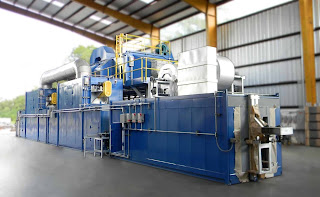
Epcon Industrial Systems designed, built and shipped a state-of-the-art multi-zone conveyor oven system that will be used to cure internal linings for 55-gallon drums. The effective heating zone oven measures 100 feet long x 6 feet wide x 6 feet, 6 inches high. The custom-designed oven has three independently controlled heating zones operating at a temperature range of 350-600°F and three dual-lane conveyor systems to process the drum and the top/bottom lids simultaneously. The dual-lane conveyor systems offer the end-user the advantage of minimizing floor space and reducing the operating cost by approximately 30% compared to a conventional approach of installing separate oven systems for drum and lids. Click on https://epconlp.com to visit us. Here is the featured Article https://www.industrialheating.com/articles/94202-tier-1-automotive-supplier-orders-batch-ovens

Maintaining Uniform Target Temperature

Image
There are various processes where temperatures and other operating parameters in the oven must be controlled accurately in real-time with minimal delays. Taking a metal curing process as a viable example, we must acknowledge that the production of adhesives or various polymers materials and their bonding to the metal surface is a highly temperature-sensitive process. The temperature affects the reaction kinetics and, more importantly, the atomic structure of the particular substance. The conversions of the atomic structure configurations occur at a specific temperature, and reaching the nearest temperature to target one is essential for manufacturing durable and high strength materials. One of the most troublesome issues in industrial ovens applications is maintaining the target temperature uniformly across all oven sections. The excessive production demands and the highest quality products are followed by overwhelming operating costs, especially in the aerospace industry. Manufactur...

Epcon Featured Project in Powder & Bulk Solids Magazine

Image
Aluminum Parts Drying Oven Dry-off or drying ovens are a critical final step in many production processes with temperatures that can range from just above ambient up to 1000°F. Utilized across a wide range of applications, these ovens are not only useful for simple dry-off requirements for parts production, but also used for more complex moisture reduction and sterilization processes with stringent temperature and uniformity ranges. Recently, Epcon designed a drying oven as part of a larger metal finishing system for a new facility for an Aluminum parts producer. Located at the exit end of the Washline, the oven dries the parts so they are ready for the final painting and curing stages. By utilizing advanced airflow management and comprehensive heat recovery methods, Epcon’s engineers were able to maximize the overall operating thermal efficiency. Integrating the drying ovens into the comprehensive system design allows for thermal recycling and greatly reduces fuel consumpt...

Epcon Industrial Designs, Installs High-Velocity Oven

Image
Epcon Industrial Systems is a known leader in designing and building ovens and oxidizers for continuous web processing applications, where the web can be either steel or aluminum, paper, plastic, fiberglass, and/or any composite material. The company’s challenge for an automotive industry customer was designing a high-velocity oven with forced convection to process 60-inch wide steel or aluminum web. This system used Epcon’s patented technology to integrate the functionality of oven(s) with the oxidizer, to increase efficiency. The system was 100 percent installed and commissioned on a turnkey basis. For more information, Visit https://epconlp.com See the featured article on https://thermalprocessing.com/news/epcon-industrial-designs-installs-high-velocity-oven/

Industrial Curing Ovens Designed to Reduce Energy While Providing Uniform, Quality Finishes

Image
When supplying air pollution control and process heating equipment to the metals industry, beyond meeting the stringent regulations and best manufacturing practices, equipment suppliers must develop new system designs that can keep pace with technological advancements and changing demands. As these industrial systems can have an operating lifespan of 30-plus years, it is critical to think far into the future when designing and engineering anything meant to meet tomorrow’s requirements. Ultimately, environmental impacts and long-term operating costs will be the key drivers when creating any successful systems for a metals industry application. Epcon embedded these principles into patented designs and systems engineering for two projects designed for coil coating operations so that the coil coaters would benefit from optimal process solutions. The first project was a Continuous Cure Oven System for a new laminated aluminum sheet line to be operated by a manufacturer of specialty ...

Composite Manufacturer Orders Batch Ovens

Image
Epcon Industrial Systems shipped two electrically heated batch ovens to a composite manufacturer in Houston, Texas. The ovens will be used for heating tooling used for composite mouldings. The work chamber, which measures 5 feet deep x 5 feet wide x 6 feet high, is constructed with a stainless-steel liner with 8-inch-thick insulation. The unique oven design offers high-temperature capability, with a maximum temperature rating of 900°F. To know more, Please click on https://epconlp.com Read the featured Article https://www.industrialheating.com/articles/94162-composite-manufacturer-orders-batch-ovens

Epcon Builds Custom Oven for Wicket Ovens

Image
Epcon has been active in the 55 gallon steel drum manufacturing industry for 45+ year. This special proprietary system for dual laying and triple laying Wicket Ovens. These Ovens were designed and manufactured for a repeat customer. These Ovens are intended for high-production efficiency, processing between 720-750 Drums per Hour. Constructed of aluminized steel inside and Carbon steel outside, these robust Wicket Ovens operate at 500 °F and feature high speed conveyors for producing the Drum Tops and Bottoms. For more information, Visit https://epconlp.com See the featured article on https://www.modernmetals.com/item/15518-epcon-builds-custom-over-for-wicket-ovens.html

Epcon’s Technologies is the Bridge Success

Image
Epcon has been in the business of manufacturing, selling, and developing patented technologies relevant to recuperative thermal oxidizers and regenerative thermal oxidizers since 1977, long before Climate Change was widely accepted corporate agenda. But as environmental concerns within ESGs reporting have steadily been mounting, so have the efficiency of technologies our oxidizers and pollution abatement systems.   Our systems rely upon the concept of a chemical reaction – one involving organic hydrocarbons being processed. In this oxidation process, the volatile organic compounds and pollutants within the air stream – are broken down from their original constituents and reformed into new compounds. Heat and oxygen are used to breakdown the hydrocarbons, thus the term Thermal Oxidation. In deciding how to best apply one of our state-of-the-art Thermal Oxidizers into an existing industrial process, complex factors such as volumetric flow, volatile organic compound loading, and ...

Thermal Deoiling Replaces Liquid Based Degreasing

Image
A major manufacturer of automobile air conditioners had been deoiling metal parts in a conveyorized solvent based vapor degreasing line, but the state environmental agency mandated that the line be shut down on a certain date due to the excessive water and air pollution it generated.   The facility uses aluminum parts of various geometry and weight in the fabrication of automobile air conditioner evaporators. The parts are formed in stamping machines in which oil is used as a drawing lubricant. Brazing of the parts is accomplished in a vacuum furnace that requires clean and dry parts to prevent failures of the brazed surfaces. The need for clean, dry parts in manufacturing processes is increasing because of increased emphases on quality and reliability.   At the same time, the costs of compliance with rules and regulations governing industrial hygiene, safety and the environment are forcing manufacturers to reevaluate cleaning methods. In aqueous cleaning and solvent bas...

Thermal Cleaning Process of Metal Parts

Image
Epcon Industrial Systems, recently designed and built an evaporative deoiling system for cleaning aluminum fins. Thermal deoiling is a state-of-the-art degreasing system, apt to replace solvent-based cleaning technologies wherever appropriate. Thermal deoiling is pollution-free, energy efficient and cost-effective. Epcon has taken a lead in bringing this technology to the forefront. Small aluminum parts of various geometry and weight are used in building the evaporator of an automobile. During the stamping process oil is used as a lubricant, and the usual practice is to use a solvent such as tetrachloroethylene to deoil the parts, so that there is no interference with braze joint quality performed in a Vacuum or Controlled Atmosphere furnace. The evaporator parts pass through the oven on an I-beam conveyor monorail located inside the oven. The oily evaporator fins nestled tightly together are placed into stainless steel rod and wire mesh baskets, which are placed into a basket hold...