Posts

Showing posts with the label Thermal Cleaning

Thermal Cleaning Technology : The Sustainable Alternative

Image
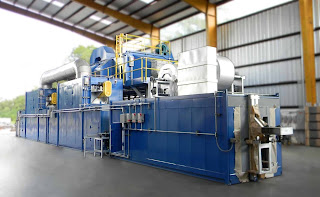
Epcon holds several patents for thermal cleaning solutions . As industry experts in custom thermal deoilers , let our team show you solutions that are not only more cost-effective, but also environmentally sound alternatives to traditional industrial cleaning methods. Read more https://digitaledition.industrialheating.com/march-2023/thermal-cleaning-technology/?oly_enc_id=5123J8679290D9Z

A Case for Thermal Deoiling

Image
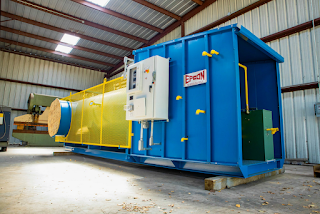
The Problem A major Air Conditioning company needed an alternate technology for degreasing evaporator fins. They had, until recently, been deoiling metal parts in a conveyorized solvent based vapor degreasing line. The degreasing technology being used over the years to clean these fins was inefficient and additionally costing millions of dollars a year for water, chemicals and the disposal. In aqueous and solvent based cleaning methods there are not only costs associated with purchasing chemicals, but also disposal costs, high operation and maintenance costs and risk management costs. At the same time, the costs of compliance with rules and regulations governing industrial hygiene, safety and the environment was forcing the manufacturing to reevaluate cleaning methods. Epcon had an initial meeting and proposed a Thermal Cleaning technology –a thermal Deoiler. The Process Thermal Deoiling is a process that uses indirectly heated dry air to clean parts contaminated with oils...

Epcon’s Technologies is the Bridge Success

Image
Epcon has been in the business of manufacturing, selling, and developing patented technologies relevant to recuperative thermal oxidizers and regenerative thermal oxidizers since 1977, long before Climate Change was widely accepted corporate agenda. But as environmental concerns within ESGs reporting have steadily been mounting, so have the efficiency of technologies our oxidizers and pollution abatement systems.   Our systems rely upon the concept of a chemical reaction – one involving organic hydrocarbons being processed. In this oxidation process, the volatile organic compounds and pollutants within the air stream – are broken down from their original constituents and reformed into new compounds. Heat and oxygen are used to breakdown the hydrocarbons, thus the term Thermal Oxidation. In deciding how to best apply one of our state-of-the-art Thermal Oxidizers into an existing industrial process, complex factors such as volumetric flow, volatile organic compound loading, and ...

Thermal Deoiling Replaces Liquid Based Degreasing

Image
A major manufacturer of automobile air conditioners had been deoiling metal parts in a conveyorized solvent based vapor degreasing line, but the state environmental agency mandated that the line be shut down on a certain date due to the excessive water and air pollution it generated.   The facility uses aluminum parts of various geometry and weight in the fabrication of automobile air conditioner evaporators. The parts are formed in stamping machines in which oil is used as a drawing lubricant. Brazing of the parts is accomplished in a vacuum furnace that requires clean and dry parts to prevent failures of the brazed surfaces. The need for clean, dry parts in manufacturing processes is increasing because of increased emphases on quality and reliability.   At the same time, the costs of compliance with rules and regulations governing industrial hygiene, safety and the environment are forcing manufacturers to reevaluate cleaning methods. In aqueous cleaning and solvent bas...

Thermal Cleaning Process of Metal Parts

Image
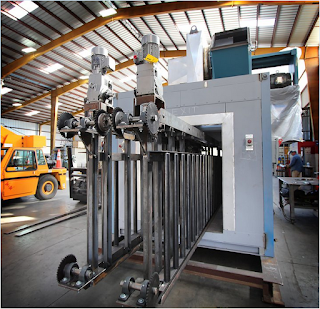
Epcon Industrial Systems, recently designed and built an evaporative deoiling system for cleaning aluminum fins. Thermal deoiling is a state-of-the-art degreasing system, apt to replace solvent-based cleaning technologies wherever appropriate. Thermal deoiling is pollution-free, energy efficient and cost-effective. Epcon has taken a lead in bringing this technology to the forefront. Small aluminum parts of various geometry and weight are used in building the evaporator of an automobile. During the stamping process oil is used as a lubricant, and the usual practice is to use a solvent such as tetrachloroethylene to deoil the parts, so that there is no interference with braze joint quality performed in a Vacuum or Controlled Atmosphere furnace. The evaporator parts pass through the oven on an I-beam conveyor monorail located inside the oven. The oily evaporator fins nestled tightly together are placed into stainless steel rod and wire mesh baskets, which are placed into a basket hold...

What is a Decontamination System & How is a Thermal Decontamination System Better?

Image
Decontamination is the process of removing or neutralizing contaminants such as explosives, volatile organic compounds (VOCs), HAPs, irritants, and various other dangerous compounds. A decontamination system not only protects workers from hazardous elements but keeps the hazards from polluting the environment as well. Additionally, they prevent designated clean areas from getting contaminated. When is a decontamination system necessary? Technological advancement has made it possible for industries to install decontamination systems to prevent environmental hazards. Here are some of the biggest reasons why you may need a proper decontamination plan for your factory: ·        As industrial processes produce a lot of volatile organic compositions or VOCs that can really harm the environment, and with increasing regulations on hazards and pollutants, a decontamination system can keep you compliant. ·         A deconta...